
Affordable AI tools for startups can help entrepreneurs launch businesses, create marketing content, automate repetitive tasks, and improve productivity without building an expensive technology stack.
Starting a business is already challenging. Between managing finances, attracting customers, creating content, and organizing daily operations, founders often have more responsibilities than they can handle alone.
Artificial intelligence offers a practical solution. However, choosing the right tools matters more than subscribing to every popular platform.
In this guide, we compare five affordable AI tools for startups in 2026, explain their strengths and limitations, and show you how to build a practical AI toolkit on a small budget.
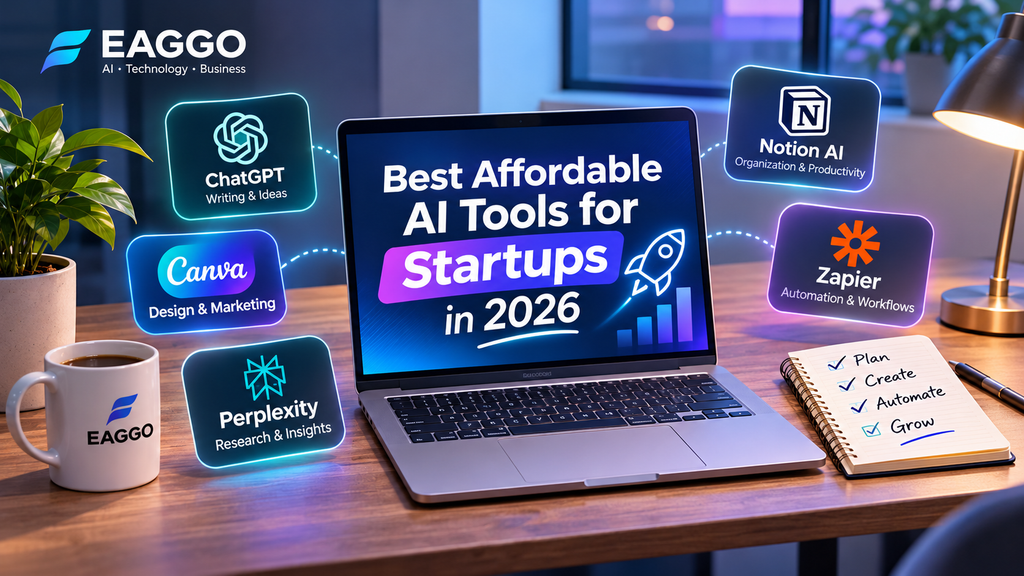
Best Affordable AI Tools for Startups: Quick Comparison
| AI Tool | Best For | Free Option |
|---|---|---|
| ChatGPT | Business ideas, writing, planning | Yes |
| Canva | Marketing designs and visual content | Yes |
| Notion AI | Organization and productivity | Limited AI trial |
| Zapier | Workflow automation | Yes |
| Perplexity | Research and information discovery | Yes |
Free features, usage limits, and subscription prices may change. Always check each provider’s official website before purchasing.
1. ChatGPT — Best for Business Ideas and Content Creation
Website: https://chatgpt.com/
ChatGPT is a versatile AI assistant for entrepreneurs who need support with business planning, writing, brainstorming, and problem-solving.
Instead of hiring separate specialists for every small task, founders can use ChatGPT to prepare first drafts, explore ideas, organize information, and evaluate different approaches.
What Can Startups Do With ChatGPT?
- Generate and evaluate small-business ideas.
- Draft marketing emails and social media captions.
- Create customer service response templates.
- Outline business plans and marketing strategies.
- Brainstorm product names and positioning.
- Analyze uploaded business information.
Practical Example
Imagine launching an online clothing store with a limited marketing budget.
You could ask ChatGPT:
“Create a 30-day Instagram marketing plan for a new online clothing store with a $100 advertising budget. Include daily content ideas, promotional campaigns, and measurable goals.”
The result can provide a useful starting point, although the business owner should review the recommendations before implementation.
For startups working with limited budgets, Canva is one of the most accessible design platforms available. When comparing affordable AI tools for startups, entrepreneurs should consider Canva for creating marketing materials, social media graphics, presentations, and brand assets without hiring a professional designer.
Its AI-powered features can also help small teams speed up creative workflows, although some advanced capabilities may require a paid subscription.
Pricing and Limitations
ChatGPT offers a free plan, while paid subscriptions provide expanded access to certain capabilities and usage limits.
Best for: Entrepreneurs who need one flexible assistant for multiple business activities.
Limitations: AI-generated information can be inaccurate. Verify financial, legal, and market information before relying on it.
Verdict: A strong first AI tool for founders who want to experiment without immediately paying for several subscriptions.
2. Canva — Best for AI-Assisted Marketing and Design
Website: https://www.canva.com/
Professional-looking marketing materials can help a small business establish credibility, but hiring a designer for every advertisement or social media post may be expensive.
Canva offers an accessible design platform with templates and AI-assisted creative features.
What Can Startups Do With Canva?
- Design social media posts and advertisements.
- Create presentations and promotional materials.
- Prepare product graphics and website visuals.
- Develop simple brand identity materials.
- Adapt designs for different marketing channels.
Practical Example
A new coffee shop could use Canva to create a promotional campaign featuring its opening offer, menu highlights, and social media announcements.
The business owner could begin with a template, customize the brand colors, add product photographs, and export the finished design.
Pricing and Limitations
Canva provides a free offering, while certain premium templates, brand-management capabilities, and AI features require paid access or have usage limits.
Best for: Small businesses that regularly publish visual marketing content.
Limitations: Templates can look generic without customization, and AI-generated designs still need human review.
Verdict: A practical choice for entrepreneurs who need consistent visual content without advanced design experience.
3. Notion AI — Best for Startup Organization and Productivity
Website: https://www.notion.com/
Startup founders often manage tasks, ideas, documents, and business information across several applications.
Notion brings much of this information into one workspace, with AI capabilities available depending on the subscription and trial access.
What Can Startups Do With Notion?
- Create business dashboards.
- Organize projects and deadlines.
- Maintain content calendars.
- Store meeting notes and operating procedures.
- Track business goals and responsibilities.
- Use available AI features to assist with writing and information organization.
Practical Example
A freelance marketing agency could create a Notion workspace containing client projects, campaign deadlines, content calendars, and meeting notes.
Instead of searching through disconnected files, the founder could keep essential information in one organized location.
Pricing and Limitations
Notion has a free plan for basic organization. Its AI features are more restricted and may only be available through limited trials or eligible paid plans.
Best for: Entrepreneurs who struggle with organization or manage multiple projects.
Limitations: Building a complicated workspace can consume more time than it saves. Start with a simple dashboard.
Verdict: Useful for organizing a growing business, even before investing in premium AI features.
4. Zapier — Best for Automating Repetitive Business Tasks
Website: https://zapier.com/
Repetitive administrative work can prevent entrepreneurs from focusing on customers and business development.
Zapier helps connect different applications and automate workflows with limited or no coding.
What Can Startups Automate?
- Transfer form submissions into spreadsheets.
- Send notifications when new leads arrive.
- Create tasks after customer inquiries.
- Update records between connected applications.
- Build simple automated follow-up workflows.
Practical Example
Consider a small consulting business receiving inquiries through an online form.
A simple Zapier workflow could:
- Detect a new form submission.
- Add the contact information to a spreadsheet.
This reduces manual data entry and helps the founder maintain an organized lead list.
Pricing and Limitations
Zapier’s free plan currently includes 100 tasks per month and supports basic two-step workflows. More complex automation and higher usage limits may require a paid plan.
Best for: Businesses already using several digital tools.
Limitations: Automation can create errors if workflows are configured incorrectly. Test each workflow before relying on it.
Verdict: Start with one repetitive task and expand automation only when the benefits are measurable.
5. Perplexity — Best for Business Research
Website: https://www.perplexity.ai/
Research is essential when evaluating markets, understanding competitors, or exploring new business opportunities.
Perplexity is an AI-powered research assistant designed to provide answers with links to supporting sources.
What Can Startups Do With Perplexity?
- Explore market trends.
- Research industries and business models.
- Compare software categories.
- Find publicly available industry information.
- Identify sources for further investigation.
Practical Example
An entrepreneur planning to start a home cleaning business could research common service categories, customer concerns, and industry practices.
Perplexity could help identify useful sources, which the entrepreneur should then inspect directly.
Pricing and Limitations
Perplexity offers a free plan for basic research, with paid options for expanded capabilities and usage.
Best for: Entrepreneurs who regularly research unfamiliar topics.
Limitations: Citations do not guarantee that every conclusion is accurate. Check original sources, publication dates, and local relevance.
Verdict: A useful research companion, particularly when decisions require information from multiple sources.
How to Choose Affordable AI Tools for Startups
The best AI tool is not necessarily the most powerful or expensive. It is the one that solves a real business problem.
1. Identify Your Biggest Challenge
Before choosing software, identify where you lose the most time.
If your main challenge is marketing content, consider ChatGPT or Canva. If you struggle with organization, begin with Notion. If repetitive administration is slowing you down, explore Zapier.
2. Start With Free Plans
Free plans allow you to test whether a tool fits your workflow before making a financial commitment.
Do not subscribe to multiple premium platforms immediately. Test one tool, measure its value, and upgrade only when necessary.
3. Calculate Return on Investment
Imagine an AI tool costs $20 per month and saves five hours of work.
Its cost per hour saved would be:
$20 ÷ 5 hours = $4 per hour saved
Whether that represents good value depends on how useful those hours are to your business.
Time savings alone are not enough. The tool should also produce reliable results.
4. Protect Business Information
Avoid entering confidential customer details, passwords, financial records, or sensitive business information into AI platforms without reviewing their privacy and data-handling policies.
Use appropriate access controls and review how your information may be stored or processed.
5. Review Results Every Month
Evaluate each tool based on measurable outcomes:
- Hours saved.
- Content produced and approved.
- Leads generated.
- Administrative errors reduced.
- Operating costs avoided.
Cancel subscriptions that do not provide meaningful value.
Building an Affordable AI Toolkit: Example Budget
A new entrepreneur does not need a large software budget to begin.
| Business Need | Suggested Tool | Starting Approach |
|---|---|---|
| Planning and writing | ChatGPT | Free plan |
| Visual marketing | Canva | Free offering |
| Project organization | Notion | Free plan |
| Simple automation | Zapier | Free plan |
| Research | Perplexity | Free plan |
This combination offers a starting point without requiring a paid subscription to every platform.
However, free plans have restrictions, and certain advanced AI features may not be included.
A sensible approach is to test these tools for two to four weeks before deciding which premium features are worth paying for.
Common Mistakes Startups Make With AI Tools
Paying for Too Many Subscriptions
Several inexpensive subscriptions can quickly become a significant monthly expense.
Review your software costs regularly and remove overlapping services.
Publishing AI Content Without Reviewing It
AI-generated marketing materials may contain factual errors, weak claims, or language that does not match your brand.
Edit content carefully and add original expertise, examples, and practical insights.
Automating Broken Processes
Automation cannot solve every operational problem.
First establish a clear, reliable process. Then consider automating the repetitive steps.
Ignoring Customer Experience
AI should support customer relationships, not replace every human interaction.
For complaints, sensitive situations, or complex customer requests, human review may still be necessary.
Frequently Asked Questions
What are the best affordable AI tools for startups?
ChatGPT, Canva, Notion AI, Zapier, and Perplexity are useful options for different business needs, including writing, design, organization, automation, and research.
Can I start using AI tools without spending money?
Yes. Several platforms offer free plans or limited trials. Their capabilities and usage limits vary, so check the terms before depending on a specific feature.
Which AI tool should a new entrepreneur try first?
For general planning, brainstorming, and writing, ChatGPT is a flexible starting point. For visual marketing, Canva may be more relevant.
Can AI tools replace employees?
AI can assist with repetitive and information-based tasks, but businesses still need human judgment, quality control, and accountability.
How many AI tools does a startup need?
Many early-stage businesses can begin with two or three tools. Add more only when there is a clear operational need.
Final Thoughts
Affordable AI tools for startups can make entrepreneurship more accessible by helping founders work efficiently, create content, organize projects, and automate selected tasks.
The most effective strategy is to start with free options, focus on genuine business needs, and measure results before increasing software spending.
AI is not a substitute for a strong business idea, customer understanding, or disciplined execution. It is a tool that can support those fundamentals.
At EAGGO, our mission is simple:
Start Small. Build Smart.
Explore more practical business and technology guides at EAGGO.
Leave a Reply